
Up to 50 tons are caught per day. We visited the "Novinki" fish farm, where fish are currently being moved for wintering.
If the forest smells of mushrooms, then at JSC "Rybkhoz "Novinki", located in the Postavy district of the Vitebsk region, a pleasant smell of fresh fish hovers, as if you are holding freshly caught carp in your hands. And it's understandable – right before our eyes, there is a massive relocation of underwater inhabitants to their winter quarters.
Staying for the Winter
In September-November, Rybkhoz "Novinki" transplants fish from nursery and feeding ponds to wintering ponds. If the former are one hundred to one hundred and fifty hectares in size, the latter are only about a hectare. From there, even if there is half a meter of ice, it is easy to catch fish and send them for sale. It is simply impossible to sell all live products in the fall – about 40-50 tons of carp, silver carp, and grass carp are caught from the pond per day. – We start catching fish from nursery and feeding ponds at the end of August, – says Dmitry Spalvis, Deputy Director for Commercial Affairs. – The main thing is that there is no heat – at high temperatures, fish tolerate catching poorly, they can die. Traditionally, we finish catching by the Day of Agricultural Workers. We drain water from the ponds into the river. They will be empty until the end of January to freeze the pond beds. Subsequently, we will start filling the feeding ponds for growing a new crop of fish.
From the Tub to the Pond
The life of carp, catfish, pike, and tench at the farm begins in the incubation workshop, where sensors maintain a constant water temperature. Large vats are installed here for spawning. The miracle of creation begins when 2-3 pairs of adult individuals are released into two-cubic-meter tanks, ten of which are in the workshop. Millions of eggs are obtained at the output. No one can give an exact number, but they say that after spawning, all artificial plants (brushes) located along the walls of the mini-pools are covered with roe. Optimal conditions, such as temperature and water flow, are maintained until the fry hatch.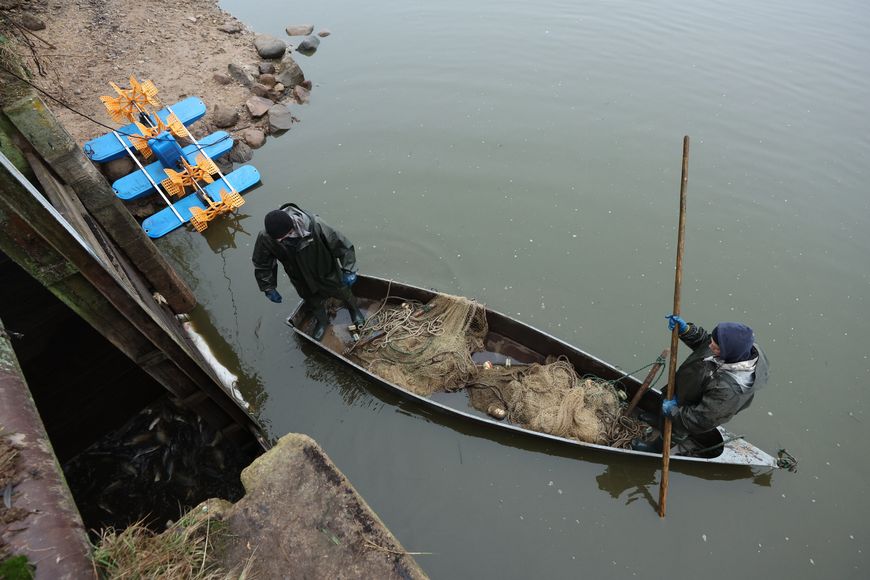 When the offspring grow, they are either released into their own ponds or sold to other organizations for stocking reservoirs. The production cycle is three years. In the first year, yearlings are raised, up to 35-40 grams. During this period, they gain weight the fastest, increasing in size by 40-45 times. In the second year, they gain a mass of 250-300 grams, and by the end of the third year, they grow into commercial fish weighing 1.5-2.5 kg. These are then placed in overwintering ponds to be sold from autumn to spring. Of course, a carp can grow up to a meter in size, but it will eat so much during this time that it will literally become golden.
Carp, although they look large, literally fast for most of the year. They actively feed from May to mid-August. The rest of the time they stand in the water and hardly move, losing weight. However, during the summer season, the farm's fish population can consume about 60 tons of feed per day.
Full Net
Before catching fish from the fattening ponds, they are "whistled" – fresh water is supplied, and the inhabitants of the depths, sensing its inflow, line up along the banks. After that, the fishermen walk along the edge, stomping their feet and slapping the surface with rods, driving their charges towards a fifty-meter net. With its help, the carp are drawn into a fish collector, from which they are transferred to fish trucks. The catch at a time is over ten tons. But to pull all the fish out of a hundred-hectare pond takes a week and a half.
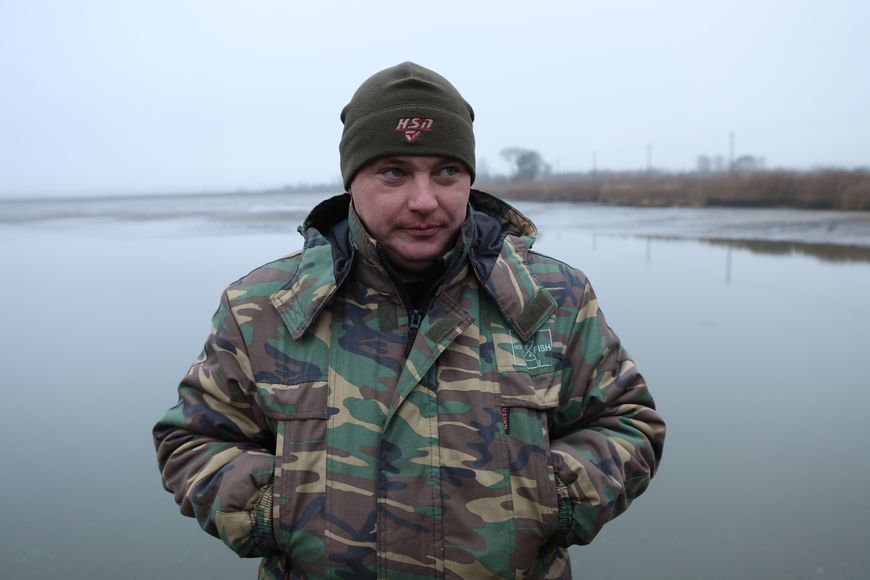
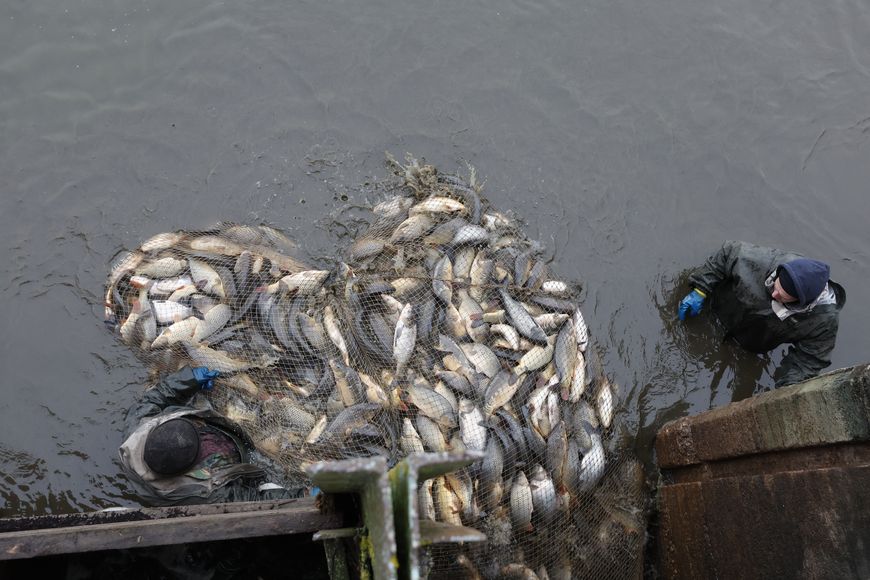 – The weather is good for fish now, they tolerate transportation easily, – says Evgeny Kiselev, head of the growing system section. – Fish are afraid not of cold, but of heat. I am responsible for seven large ponds, from 88 to 155 hectares. On average, we get 200 tons of fish from 100 hectares. I mainly have carp, silver carp, grass carp, and pike.
The live catch is brought to the sorting shop, where it is sorted by size and species by hand to be sent to wintering ponds. Each pond houses its own species: elite carp, silver carp, or grass carp.
– Sorting is a manual process, it cannot be automated. A person works many times faster than robots, – explains Dmitry Spalvis. – Yesterday, we sorted 46 tons in a day. Everything must be done quickly – the caught fish will not wait. We immediately load them into fish trucks and send them to wintering ponds or for sale.
The interlocutor claims that it sometimes takes a week to sell a cistern of fish (2-3 tons) at retail. And we are heading to the nearest wintering pond. An aerator, remotely resembling a catamaran, spins its blades on the surface. About a dozen seagulls circle over the water, but carp are "not to their taste." The birds look for crucian carp, unintentionally helping the fish farmers.
Winged Pests
The farm has many enemies: beavers building dams, gray herons waddling along the ponds. But the main one is the cormorant, a large predatory bird with a hook at the end of its beak.
– A cormorant needs a kilogram of fish per day, – says Dmitry Spalvis. – But it’s one thing when it eats an adult specimen, and quite another when a flock of cormorants attacks fry weighing 30-40 grams. To get full, one cormorant needs about 20 fish. Therefore, our main task is to withstand their pressure in the spring.
The farm has a permit to shoot almost one and a half thousand feathered "poachers" per year, but this does not solve the problem. Gas cannons are also used for scaring them away; they are placed on dams and on rubber boats moored in the middle of the pond. The problem is that cormorants get used to monotonous sounds.
Another fish lover is the white-tailed eagle. Its wingspan is up to 2.5 meters. When this bird flies over the road, it occupies its entire width. But the farm tolerates the eagles – there are not many of them, and they are listed in the Red Book.
Tasty Assortment
– We mainly focus on carp species, – says Dmitry Spalvis. – Carp, silver carp, grass carp. We incubate pike, and are attempting to breed catfish and tench. According to the plan, by 2025, we are expected to produce 1050 tons of products, including over 700 tons of marketable fish. As of early November, we already have 950 tons. We sell fish within the Vitebsk region, where we are the only fish farm. We also transport customer-supplied raw materials to Braslav, where they are used to make canned goods.
According to the investment program for 2026-2027, it is planned to build our own processing plant on the farm's territory for freezing, salting, and smoking fish.
A pleasant bonus for anglers is also offered here. From May 1st to September 30th, anyone can visit the "Novinki" Fish Farm and, after purchasing a ticket for 30 rubles, try their luck at fishing with a rod. One ticket allows for catching up to 4 kilograms; any excess catch must be paid for additionally. Anglers come from all over Belarus for the fishing adrenaline. This year, over 6,000 tickets were sold.
1. The total area of the pond fund in the farm is about a thousand hectares. Water is supplied to the reservoirs from the Lasitsa and Golbeitsa rivers. 60 people work at the "Novinki" Fish Farm.
2. The "Novinki" Fish Farm was established shortly after the reunification of the Western and Eastern parts of Belarus in 1939. The enterprise was created on the site of a former noble fish farm. After the war, the area of the fish farm was increased almost tenfold.